
CirBE – Turning Waste into Resources and Advancing the Circular Economy with “Made in Vietnam” Technology
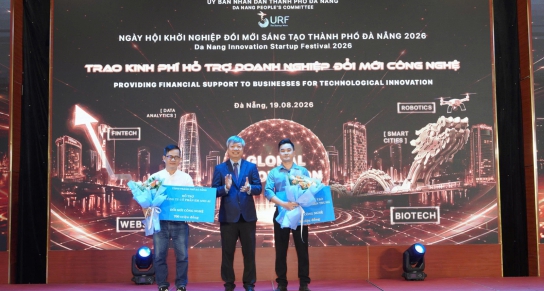
Selected among the Top 10 projects of the Da Nang Innovation Startup Festival 2026 (SURF 2026), CirBE – Circular Bioenergy Joint Stock Company is developing a “Made in Vietnam” environmental technology solution for treating mixed municipal solid waste and accumulated landfill waste using proprietary microbial technology developed by its research and development team.
Without requiring waste segregation at source, incineration, or the use of chemicals, CirBE aims to transform complex waste streams into value-added products, contributing to the development of a circular economy model in Vietnam.
.jpg)
Solving Waste Management Challenges through Biotechnology
In Vietnam, most municipal solid waste is still disposed of through landfilling, while many landfill sites are facing the risk of reaching or exceeding their capacity. This not only puts pressure on land resources but also creates environmental challenges related to leachate and greenhouse gas emissions.
Against this backdrop, CirBE is focusing on developing low-cost solutions for treating complex waste streams, targeting overloaded landfill sites and areas where effective waste segregation at source remains difficult.
The key differentiator of CirBE’s technology lies in its application of a microorganism-based biological system that enables waste treatment without requiring source segregation, incineration, or the use of chemicals. Rather than viewing waste as the end point of a consumption cycle, CirBE treats waste as a source of materials that can be recovered, recycled, and transformed into new products.
One Waste Stream – Multiple Economic Values
.jpg)
Treatment Process
From a single incoming waste stream, CirBE has developed a model that generates multiple product streams and parallel revenue sources. Its core solutions include microbial composting, material recovery, wastewater treatment, and the production of energy pellets.
Under this model, the company can generate revenue simultaneously from waste reception and treatment fees, microbial organic fertilizers, recovered solid fuels such as RDF/SRF, and recycled plastic pellets. In the next phase, CirBE aims to develop an additional revenue stream from carbon credits under international standards such as Verra and the Gold Standard, with this revenue expected to be generated from the third or fourth year of operation.
This approach creates a closed-loop value chain in which waste is not only treated to reduce environmental impacts but also transformed into resources, products, and new revenue streams.
It also provides a foundation for CirBE to pursue a circular economy model while contributing to multiple Sustainable Development Goals, including climate action, water protection, and the development of healthy communities.
A Flexible Partnership Model, Scaling Through Real-World Applications
Beyond its technology focus, CirBE has also developed an implementation model designed to reduce upfront investment pressure and facilitate replication across different localities.
Under this model, the company applies a 70/30 co-investment structure, combined with joint operation and a 50/50 profit-sharing arrangement with local partners. This approach enables CirBE to combine its technological and operational capabilities with the resources and existing conditions available in each locality.
The model is designed on a modular basis, allowing waste treatment systems to be expanded according to the needs and scale of each area, rather than relying on a single large-scale project requiring substantial upfront investment.
This approach is well suited to the characteristics of waste treatment challenges in Vietnam, where needs and environmental infrastructure conditions vary significantly from one locality to another.
CirBE’s implementation capacity has already been demonstrated through real-world projects. The company currently operates two municipal solid waste treatment plants in Thanh Hoa and Dong Thap, while a third plant is under construction in Ha Tinh.
These initial results provide a foundation for CirBE to further refine its technology and operating model and gradually expand its application.
SURF 2026 – An Opportunity to Connect and Expand Across Central Vietnam
Being selected among the Top 10 projects of SURF 2026 gives CirBE an opportunity to showcase its “Made in Vietnam” environmental technology to businesses, investors, organizations, and partners across the innovation and startup ecosystem.
In particular, through its participation in SURF 2026, CirBE aims to seek potential partners and expand its market presence in Da Nang and Central Vietnam. This is an important step in the company’s network development strategy, laying the groundwork for gradually scaling its operations nationwide before expanding into international markets.
As a city actively promoting a green economy, digital transformation, and sustainable growth models, Da Nang also offers significant potential for CirBE to explore partnerships and deploy circular waste treatment solutions.
CirBE’s journey demonstrates that innovation in the environmental sector is not only about developing new waste treatment technologies, but also about transforming environmental challenges into economically viable models capable of generating value and being scaled.
From microorganism-based technology researched and developed by a Vietnamese team to a model based on co-investment, joint operation, and profit sharing with local partners, CirBE is gradually pursuing a new approach to waste management: not simply treating waste, but transforming waste into resources and creating new value for communities.
As a Top 10 project of SURF 2026, CirBE has gained an important platform to connect with potential partners in Da Nang, expand into the Central Vietnam market, and advance its ambition to bring Vietnamese environmental technology solutions to the wider region.