

Da Nang Promotes Research Cooperation and Technology Transfer with the Vietnam Academy of Science and Technology
On the afternoon of August 10, 2026, in Hanoi, a delegation from the Da Nang City People’s Committee, led by Mr. Nguyen Manh Hung, Deputy Secretary of the Da Nang Party Committee and Chairman of the Da Nang City People’s Committee, held a working session with the Vietnam Academy of Science and Technology (VAST) to promote cooperation in scientific research, technology transfer, innovation, and digital transformation, contributing to the city’s socio-economic development in the new period.
.jpg)
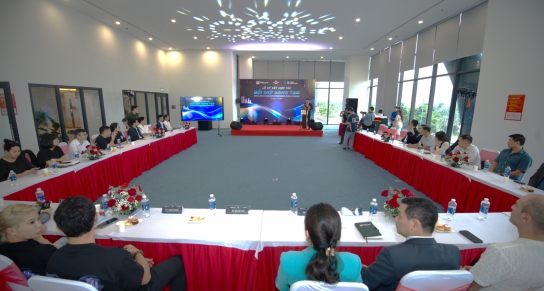
An overview of the working session
.jpg)
Prof. Dr. Tran Hong Thai, Member of the Party Central Committee, Secretary of the Party Committee and President of the Vietnam Academy of Science and Technology, chaired the working session.
The working session was chaired by Prof. Dr. Tran Hong Thai, Member of the Party Central Committee, Secretary of the Party Committee, and President of the Vietnam Academy of Science and Technology. The session was held as part of the implementation of the Memorandum of Understanding on cooperation in scientific research, technology transfer, innovation, and digital transformation for the 2026–2030 period between the Da Nang City People’s Committee and the Vietnam Academy of Science and Technology, which was signed on July 6, 2026.
.jpg)
Mr. Nguyen Manh Hung, Deputy Secretary of the Da Nang Party Committee and Chairman of the Da Nang City People’s Committee, delivers remarks at the working session.
Speaking at the working session, Mr. Nguyen Manh Hung, Deputy Secretary of the Da Nang Party Committee and Chairman of the Da Nang City People’s Committee, emphasized that the cooperation between Da Nang City and the Vietnam Academy of Science and Technology (VAST) has achieved significant results in recent years across various areas, including scientific research, technology transfer, innovation, and environmental protection.
During the 2026–2030 period, the two sides will continue to strengthen cooperation in research, development, and technology transfer; training and developing high-quality human resources; advancing high-tech, strategic, and core technologies; and building an innovation and startup ecosystem.
In particular, the two sides will focus on developing research programs, supporting investment promotion for the Da Nang Science Park, developing a medicinal plant industrial center with Ngoc Linh ginseng as its key crop, and strengthening linkages between research institutes and businesses to bring research results into practical applications. These efforts will promote technology transfer and commercialization, contributing to addressing development challenges and fostering the city’s socio-economic development.
Expanding Scientific and Technological Cooperation to Address Da Nang’s Development Challenges
During the 2016 - 2026 period, cooperation between the Vietnam Academy of Science and Technology (VAST) and Da Nang City, including Quang Nam Province prior to the administrative reorganization, was implemented across various fields, including scientific research, technology transfer, environmental protection, natural resource conservation, high-tech applications, and innovation.
According to a report by the Da Nang Department of Science and Technology, during this period, VAST implemented more than 30 research projects in Da Nang, with total estimated funding of over VND 22 billion. The outcomes of this cooperation have contributed to strengthening the city’s scientific and technological capacity, supporting the development of databases for state management, and providing advanced technological solutions to address practical development needs.
Building on Resolution No. 57-NQ/TW of the Politburo on breakthroughs in the development of science, technology, innovation, and national digital transformation, and in response to Da Nang’s development requirements following the expansion of its development space, the two sides aim to deepen their cooperation, with a stronger focus on linking research with the city’s practical application needs.
Key areas of cooperation include research, technology development and transfer; commissioning of science, technology, and innovation tasks; high-quality human resource development; organization of scientific conferences, forums, and seminars; development of high-tech, strategic, and core technologies; and support for Da Nang in building an internationally oriented innovation and startup ecosystem.
Bridging Laboratory Technologies with Business Needs
As part of the program, the Da Nang City delegation visited two key laboratories of the Vietnam Academy of Science and Technology (VAST), providing an opportunity to learn about their research capacity, technology development capabilities, and potential for joint mobilization and utilization of scientific and technological resources to serve the city’s development needs.
A key focus of the working session was discussion of the potential transfer of technologies that are already ready for deployment or have strong potential for practical application, in line with the technology adoption needs of departments, agencies, and businesses in Da Nang.
The portfolio of technologies presented focused on areas with strong potential for direct application in the city, particularly technologies supporting the development of Ngoc Linh ginseng and medicinal plants, biotechnology, environmental treatment, and wastewater treatment. These included solutions such as automated monitoring systems for controlling environmental conditions, moisture, and nutrients for crops; integrated cold plasma and plasma-activated water (PAW) systems for the production of red ginseng and black ginseng; methods for producing Ngoc Linh ginseng cell biomass using bioreactors; and microbial products for environmental and wastewater treatment.
For Ngoc Linh ginseng, the automated monitoring system is designed as a multi-layer architecture comprising data collection, data transmission, AI-based analysis and decision-making, and control layers. The system can integrate environmental and soil data, growth history, and crop images, while supporting the prediction of irrigation and nutrient requirements, assessment of medicinal material quality, and detection of abnormalities. The technology currently has a Technology Readiness Level (TRL) of 4–6 and can be scaled up from pilot to industrial applications.
In addition, the technology for producing Ngoc Linh ginseng cell biomass in bioreactors has reached TRL 5 and is oriented toward industrial-scale expansion. The integrated cold plasma and plasma-activated water technology has been developed to support the processing of red ginseng, black ginseng, and other high-value-added ginseng products.
In the environmental sector, the technologies presented included EM microbial products for treating wastewater, solid waste, aquaculture ponds, and livestock waste; microbial products for wastewater treatment capable of treating water sources with varying salinity levels; and Eco-Bio-Block materials with filtration, adsorption, and microbial carrier functions, suitable for a range of water treatment applications.
From City-Level Cooperation to Specific Technology Transfer Projects
A key highlight of the program was the two sides’ efforts to foster direct connections between VAST’s research institutes and businesses and organizations in Da Nang, with the aim of bringing research outcomes to the market and addressing practical needs.
.jpg)
.jpg)
.jpg)
Memorandum of Understanding (MOU) Signing Ceremony
As part of the program, six memoranda of understanding and cooperation agreements were signed between VAST-affiliated institutes and businesses and organizations in Da Nang.
Specifically, the Institute of Physics signed an agreement with Truong Hai Agriculture Corporation – THACO AGRI for the transfer of an integrated cold plasma and plasma-activated water (PAW) system for producing red ginseng and black ginseng, supporting the development of high-value-added processed ginseng products.
The Institute of Life Sciences signed an agreement with THACO AGRI on the transfer of a method for producing Ngoc Linh ginseng (Panax vietnamensis Ha et Grushv.) cell biomass using an organic compound-supplemented medium in bioreactors, with the aim of producing biomass under controlled cultivation conditions.
In the field of applying digital technologies to medicinal plant production, the High-Tech Technology Innovation Center signed an agreement with THACO AGRI and the Ngoc Linh Ginseng and Medicinal Plants Development Center on the transfer of an automated monitoring system for controlling environmental conditions, moisture, and nutrients for crops, thereby optimizing medicinal plant cultivation and care processes. The technology transfer will be implemented for both businesses and specialized municipal organizations, expanding the application of technology in the management, cultivation, and development of medicinal plant growing areas.
In the environmental sector, the Institute of Life Sciences signed an agreement with Da Nang Drainage and Wastewater Treatment Company on the transfer of EM microbial products for environmental treatment. Meanwhile, the Institute of Energy and Environmental Sciences and Technology signed an agreement with the same company on the transfer of microbial products for wastewater treatment, meeting the city’s demand for applying biotechnology solutions to environmental and wastewater treatment.
These agreements are expected to mark a shift from research cooperation toward technology application and commercialization, thereby leveraging VAST’s scientific and technological resources alongside the capacity of Da Nang businesses to absorb and apply advanced technologies.
Towards a Stronger Science, Technology, and Innovation Ecosystem
The decision by the Da Nang City People’s Committee and the Vietnam Academy of Science and Technology (VAST) to concretize their cooperation priorities as early as 2026 demonstrates a clear commitment to strengthening the close linkage between research, technology, businesses, and the market.
Through cooperation in scientific research, technology transfer, human resource training, and laboratory development, Da Nang will gain additional scientific and technological resources to address development challenges in priority areas, while gradually building interconnected research, development, and innovation capabilities at both regional and national levels.
This cooperation also provides an important foundation for the city to continue pursuing its goal of becoming an internationally recognized innovation and startup hub, developing high-tech and strategic technologies as well as emerging economic sectors, and contributing to the realization of major national directions in science, technology, innovation, and digital transformation for the 2026–2030 period.